
“Heart of the Night” is My Best Work
- “Soad Hosny is an icon to me… and I learned from Atef El-Tayeb the importance of small details.”
- “Every role I’ve played carries a touch of my soul… and the character ‘Safsaf’ stayed with me until the start of filming ‘Ash Ash.’”
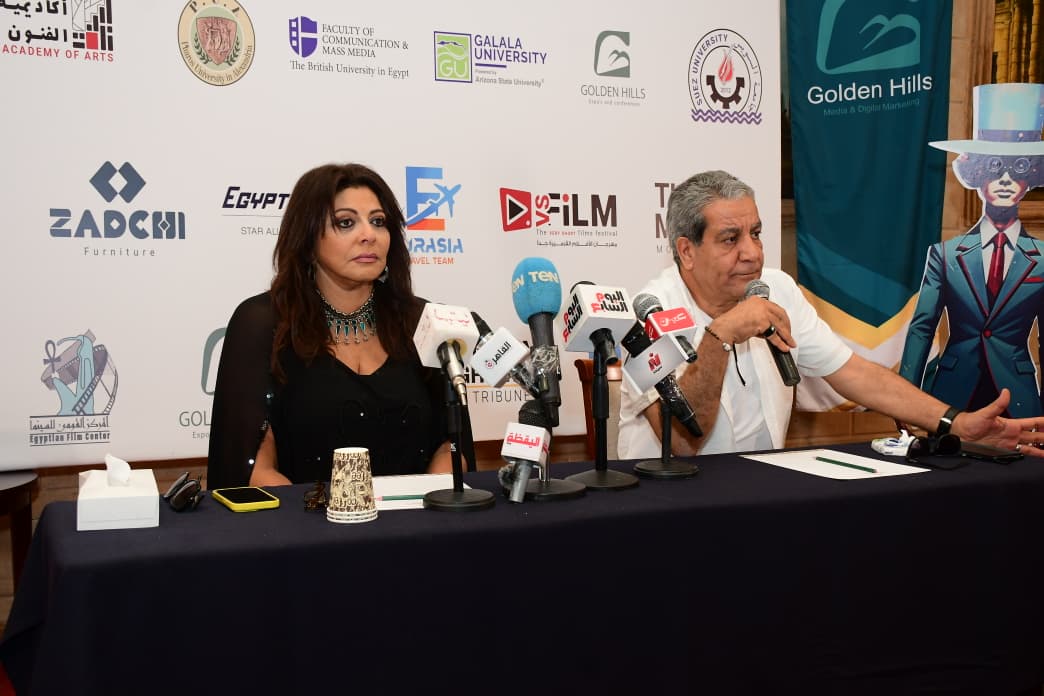
The management of the VS-Film Very Short Film Festival organized a seminar for actress Hala Sedky as part of honoring her during the festival’s second edition, currently taking place in Ain Sokhna, Suez Governorate.
The seminar was attended by a large number of stars and guests, and was moderated by critic Mohamed El-Roubi, who spoke about the key milestones in Hala Sedky’s journey — from being a swimming champion to swimming through the world of cinema. He described her career as “a slow-cooked maturity,” noting that she has worked with Egypt’s greatest directors from her early beginnings and mastered performance before even joining the Higher Institute of Theatrical Arts. He praised her performance as Marwana the shepherdess in “Heart of the Night,” adapted from Naguib Mahfouz’s novel.
At the beginning of her talk, Hala Sedky expressed her happiness and gratitude for the festival’s honor and the warm welcome she received from its organizers and guests.
She said that she feels especially proud of the film “Heart of the Night,” which she considers one of her most important works, adding that she was fortunate to have started her career working with top directors and actors who shaped her artistic identity.
She recalled that she learned from Atef El-Tayeb the importance of minute details, explaining that in “Heart of the Night” he had asked her to cut her nails and smear her hands with mud to authentically look like a shepherdess. Since then, she has always paid close attention to such details in all her roles.
She commented:
“If Atef El-Tayeb had lived longer, Hala Sedky would have reached a completely different place.”
The discussion turned to her early beginnings and childhood passion for acting, performing in school plays, and mimicking scenes in front of a mirror. She said her idol was Soad Hosny, whom she described as her personal icon and unique among Egypt’s stars.
Sedky recalled that her family initially rejected her wish to join art school, insisting that she first complete a university degree. She therefore enrolled in the Faculty of Arts, tried joining the university theater troupe, but left because she didn’t feel the group took acting seriously.
She then told the story of the chance encounter that changed her life: while at the television building to participate in a student program, she happened to walk into a studio and met director Noor El-Demerdash. She introduced herself as a swimming champion at Zamalek Club, and that small detail led him to cast her for a minor role in the series “No, My Dear Daughter.” When actress Yousra later withdrew from the series — in which she was supposed to play a swimmer — El-Demerdash chose Hala to play the lead role instead.
Hala emphasized her deep belief in the director’s power to bring out the best in actors, highlighting her strong rapport with Mohamed Sami, with whom she delivered several memorable performances.
She noted that her role as “Safsaf” in “Gaafar El-Omda” succeeded because of that creative harmony, and that Sami welcomed her suggestion to add a light Egyptian comedic spirit to the character.
Sedky also discussed her role in “Ya Donia Ya Gharamy,” describing it as a difficult part that she successfully portrayed with director Magdy Ahmed Ali’s support. She affirmed that every character she’s played carries a part of Hala Sedky’s soul.
She admitted that the character “Safsaf” continued to affect her even as she started shooting “Ash Ash,” causing some tension with director Mohamed Sami until she managed to break free from that influence and develop new distinctive features for her new role.
Finally, she revealed why she left the Higher Institute of Theatrical Arts: she had joined the institute while starring in “Anf wa Thalath Oyoun” (A Nose and Three Eyes), but dropped out after her professor Karam Motawaa asked her in one class to play the role of a tree, and in the next one, to play the sun.